When I wrote the Last Week (In Watches) Today article recently there was one watch that really stood out for me, the Laco München. Now, if you say “pilot’s chronograph with day-date” to me I immediately think of overly complicated and fussy watches. While I can understand how some of the functions could be useful in terms of navigation and operation of an aircraft in the age before modern electronics and navigation equipment, I don’t think they are that practical today. I personally prefer a simpler, cleaner look. I think this why I have unintentionally ended up with quite a dive watch heavy watch collection. I can certainly see the appeal of a time only pilot’s watch, it is all about clear legibility. Often this is achieved by using a large dial with big indices and a healthy dose of lume. A pilot’s chronograph with day-date however is not something that I would expect to like.

The Laco München is a 200 piece limited edition. It costs 1,990€ in its base format but you can also choose an upgrade to a top grade movement for an additional 130€, anti-reflective coating on both sides of the sapphire crystal for 100€ and the day display in English rather than German for 70€. I quite like the fact that there are optional extras at the checkout, although personally I would probably just stick with the original format. The sand blasted matte 42.3mm case is water resistant to 100m and it houses a modified ETA Valjoux 7750 movement, which is a well respected automatic chronograph movement.

So what are the origins of the flieger or pilot’s watch? There’s a good summary of the specification in the Military Watches of the World: Germany Part 1 – 19th Century Through World War II article on Worn and Wound. Essentially in 1935 the Reich Ministry of Aviation set out a watch specification that included a lot of the hallmarks we associate with pilot’s watches today such as onion crowns, blued hands and a triangle or arrow at 12 o’clock. Central to specification was legibility and functionality, the watch has to be large, easy to read and capable of being worn over a flight jacket or around a thigh! Five manufacturers produced the watches – A. Lange and Söhne, Wempe, Laco, I.W.C. and Stowa. Laco was first established in 1925 and as one of the five manufacturers they produced watches for the German Luftwaffe throughout the Second World War. The core of their watch collection today combines traditional pilot watch design with modern materials and sizes. You can get a traditional pilot’s watch with a 42 to 55mm case or a more basic watch in a smaller size. They also have a selection of navy watches, sport watches and chronographs.
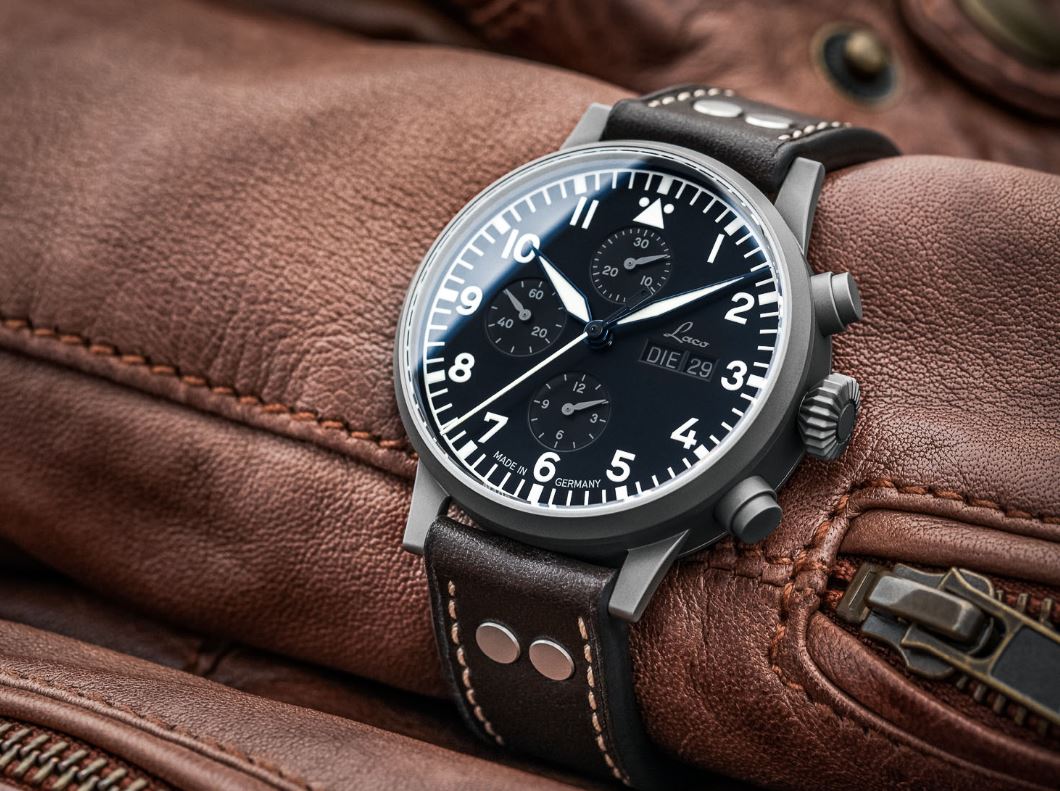
So, back to the München. The watch has a lot of the traditional flieger elements – an onion crown, blued hands, a triangle at 12 and a healthy dose of Superluminova C3.
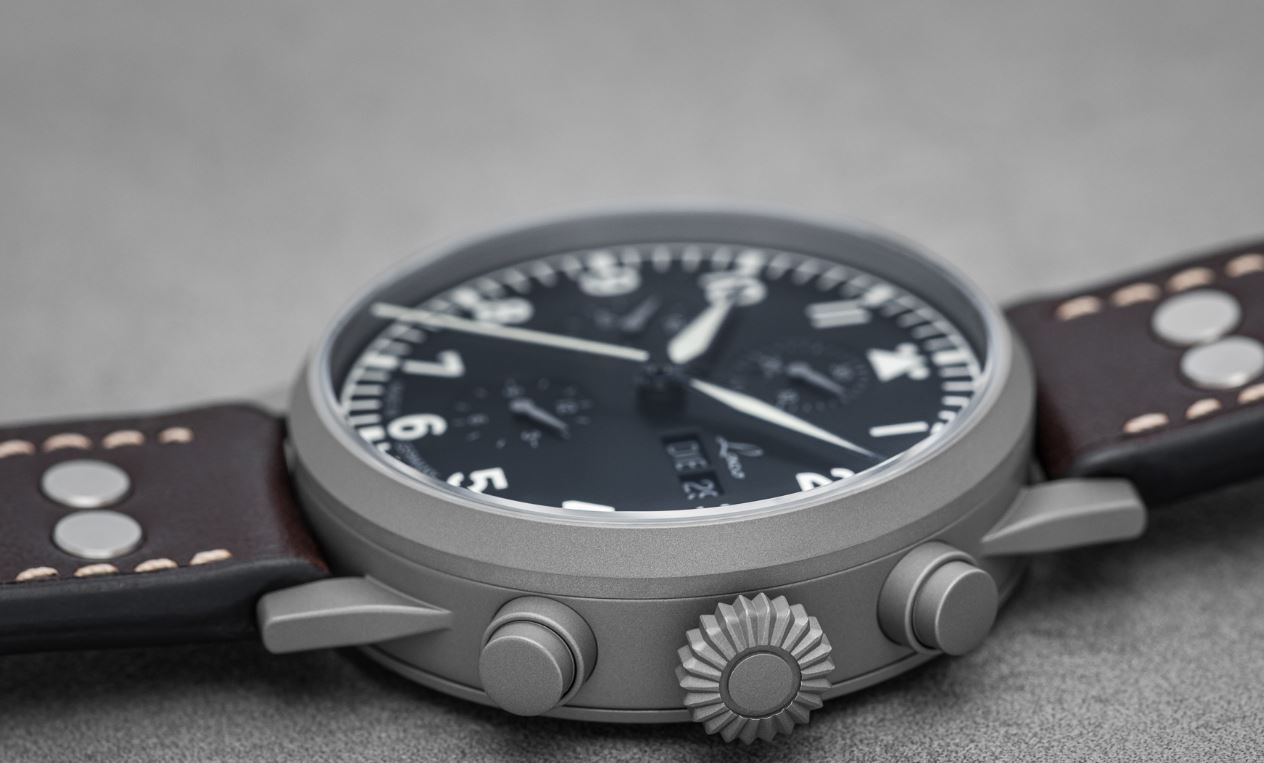
If you’ve read some of my previous articles you will know that I am a big fan of lume, in fact Gigi and I wrote an article about taking lume shots. The press photos of the lume look fantastic, it really stands out against the dark dial and matte sand blasted case.


The watch is supplied on a brown calfskin strap with double rivets. The rivets are another nod to the original Ministry of Aviation specification. I know in articles I often list out the straps that I would pair a watch with, but in this instance, based on Laco’s photos, I think I would stick with the supplied strap. It’s a really sympathetic combination that works well.
So what about the chronograph and day-date? In general I prefer a time only watch in terms of the aesthetic but I do find a date or day-date complication useful day to day so I am not overly offended if a watch has this feature as long as it is in keeping with the overall design. Chronographs, however, I do not have a use for day to day. If I’m going to time something, realistically I will use my phone. I do appreciate the horological significance of them, especially the classic Valjoux 7750, but for me they are generally not a practical addition to a watch. I think this is where Laco have done something very clever. The day-date and sub dials are dark grey and as such they disappear into the dial. It’s a different approach to contrast and legibility. The functions are there and you can see them and use them, but they don’t dominate the dial or make it look busy. The predominant look is that of a clean simple pilot’s watch. The combination of the sand blasted case, black dial and grey details is perfectly understated.
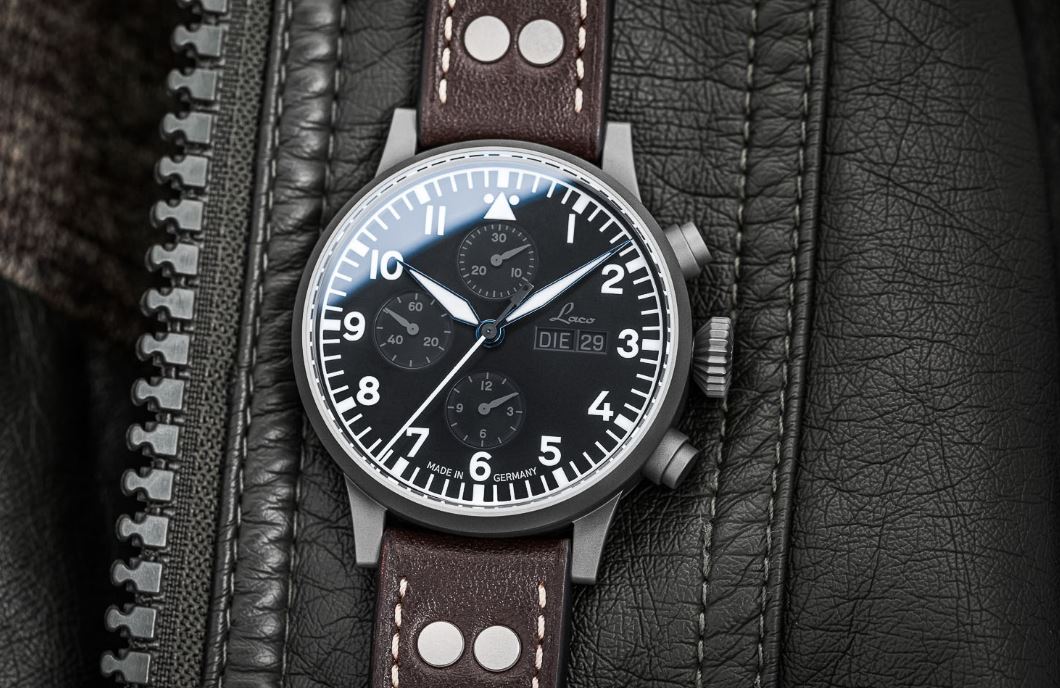
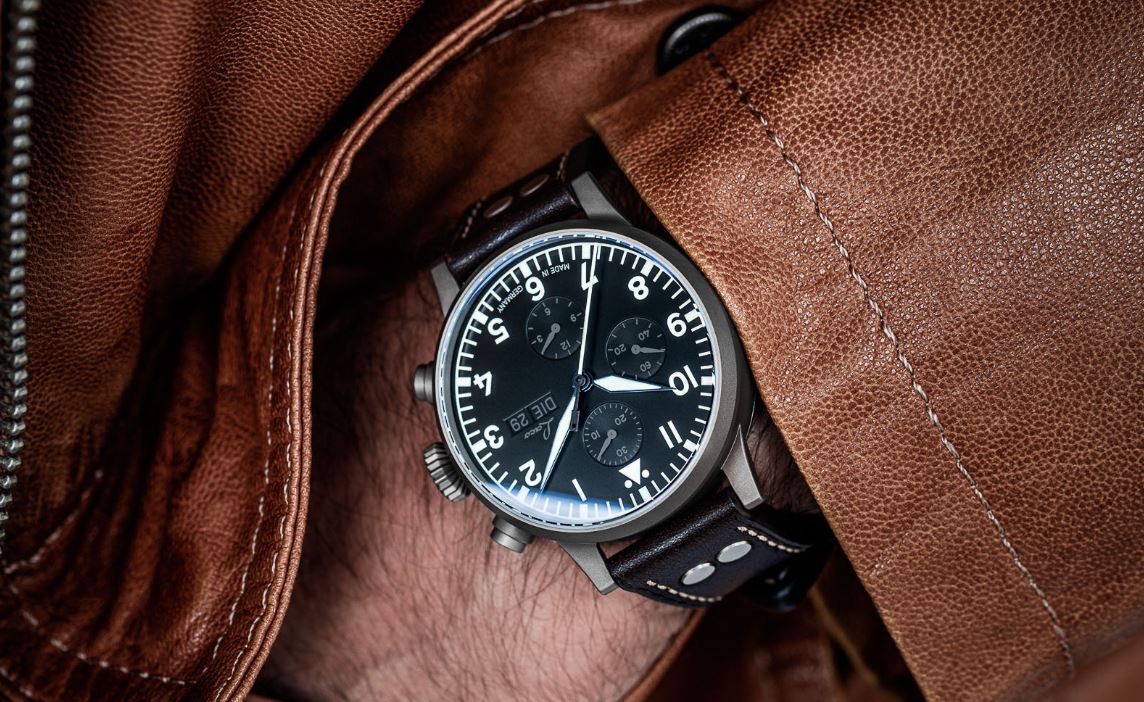
I think the Laco München has a lot going for it. It’s a good size. It has a lot of classic flieger details and a healthy dose of lume. It would make a practical day to day watch. It will look good with jeans or at a push a suit. It contains arguably one of the world’s greatest chronograph movements, the 7750 was introduced in the 1970s and is still being manufactured by various companies today, but it doesn’t dominate the watch. Throw into the mix that it’s a limited edition of only 200 pieces and I think you have something quite special. I could definitely see myself wearing this watch. I can see this being a nice addition to someone’s collection or even a one watch collection. It has plenty of features and talking points for an enthusiast.

Full time engineer and part time watch writer, Chris’s passion for watches started from a young age with his first Casio, ordered from the Argos catalogue. His interest in how things worked soon led him to mechanical watches, resulting in him wearing a 17 jewel Citizen watch throughout his teens when most of his friends were wearing digital watches. His fascination with watches waned during his time at university, but never fully went away. As a significant birthday approached Chris decided to get a proper Swiss watch, the one watch that he would have for the rest of his life. Little did he know that this would reignite his passion for watches, a passion that has expanded to include photography and writing.