

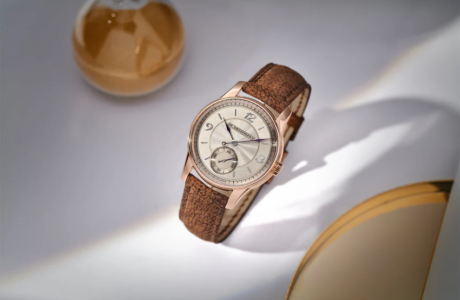
These are strange times. And no, I am not just referring to the pandemic that has brought the world to a grinding halt for the most part. What I am referring to, is an approximately US$19,280 watch that I came across on Instagram. It was not an ugly or obscene watch by any measure. In fact, the watch itself is quite elegant, with small thoughtful details that embellish it’s the simple design. However, that price, among other things, befuddles me. But I will get to that. For those who have not read the Hodinkee or SJX articles, this is the Naoya Hida Type 2A watch released late last week.

Naoya Hida is a brand that I had not heard of prior to the past couple of days. A quick search on the Internet reveals that this is a relatively new Japanese independent brand founded in early 2019. Its founder, Mr Naoya Hida has an illustrious background in the industry, having brought F.P Journe to the Japanese market in 2004 thereafter also establishing Ralph Lauren watches as a credible option in Japan. After spending most of his 29 years in the industry in marketing and distribution, Mr Naoya Hida finally started his own brand with the Type 2A being the second offering it the collection.

As mentioned above, the Type 2A is a watch that aesthetically appeals to me on most levels. Classically sized at 37mm, with a 10.7mm thickness, it is almost a perfect dress watch for my 6.5” wrist. The 904L stainless steel watch’s curved lugs and a concave bezel that slopes upwards to blend into the sapphire crystal are but some of the embellishments referred to earlier. The dial however, is where this watch really bears most of its charm. It is an interesting 3-tiered stepped German silver dial with indices on a ring a step above the centre of the dial and the minute track yet a step higher. Its engraved indices are urushi lacquer filled for a high gloss finish. All in all, a watch that I believe has to be seen in the metal to truly appreciate its beauty.


Here’s where things start to get puzzling though. The movement, is a Valjoux 7750 i.e. an automatic chronograph that has been reworked to become a manual wind movement. Now I am no movement expert, but I was under the impression that it is generally not much of a challenge to remove complications and rotors from a movement. Of course, credit is due for the reworked barrel and balance bridges and especially the winding system that features a click that is supposed to be reminiscent of vintage hand-wound movements. Still, a Valjoux 7750 is an is odd choice for a base movement. Could these modifications not have been made to an ETA 2801 hand-wound movement? I wonder. At this juncture, there is not much information that can be found on the rationale for a Valjoux 7750 as a base movement. If anyone has any idea, please let me know in the comments below. It is also unclear, at this point, what sort of finishing is done to the movement. If it is anything like the movement in the also recently released update to its first model, the Type 1C (see picture above), the finishing while good does not appear to be anything worth writing home about at least based on pictures.

The biggest kicker to me though is still the price. When this dressy elegant watch first caught my eye, I was excited. Perhaps this would be another Ming, which has been releasing some amazing dress pieces that are beautifully designed. However, I was then completely thrown by the price. Where a brand like Ming offered amazing value, this watch just left me scratching my head. And that is rare for someone like me. I am not one who scoffs at non-in-house movements or scream bloody murder at the prices of Rolexes. I try to justify the prices that most brands tag onto their watches. Even my mini rant at Seiko prices awhile back was more because of its pricing strategy as opposed to a conclusion that the watches were not worth the money. However, in this case, I was stumped. I had to do a double take to confirm that this was not a precious metal watch. Sure it is a 904L steel watch which is supposedly harder to machine, but how much premium does that put on a watch? It is not an in-house movement so there’s no premium for long term movement research or work unlike other independent brands like Laurent Ferrier, Roger Smith or Moritz Grossman. Is the watch hand-made or hand-finished? There is no information on those aspects though you would expect a marketing and distribution veteran like Mr Naoya Hida to know to include these marketing terms if it were possible. Speaking of Mr Naoya Hida, his experience in the industry while respectable does not really seem to add a premium to the watch given that he is not a watchmaker unlike Roger Smith, F.P Journe or Philippe Dufour. Which brings me back to my main question, what makes this watch a US$19,000 watch?

Photo Credit: Hodinkee
I also find it interesting that the two articles that I’ve read on this watch release, Hodinkee and SJX make no mention of how steep this price is. In Hodinkee’s article on Moritz Grossman’s Benu 37, the price tag of US$28,300 was referred to as “extremely expensive”. To be completely fair, the writers were different and price is a subjective thing after all. For argument’s sake though, let’s do a quick comparison of these two 37mm dress watches. The Moritz Grossman is approximately US$9,000 more than the Naoya Hida Type 2A. For that extra money though, you get a whopping amount of value. For one, the Benu 37 is a rose gold watch as compared to the 904L steel on the Type 2A. It also has a beautifully hand finished in-house movement that is on display for all to see. As a testament to its quality, Jack Forster stated in the afore mentioned article that its finishing and complexity of several of the components were visibly better than A Lange’s Saxonia which itself bears an extremely high standard. Can similar plaudits be given to the modified Valjoux 7750 movement hidden by a closed case back on the Naoya Type 2A?

Photo Credit: Hodinkee
One saving grace for the Type 2A is its extremely limited production which is estimated to be about 10 pieces in total. In the watch world, if produced in small enough numbers, there will always be demand for a well-made extremely exclusive watch. No doubt, these 10 pieces will sell out and the brand will continue to chug along for the time being, even if the prices seem to be wholly unjustified. Then again, I may have completely missed something and am just ignorant. What do you think? Let me know in the comments below.


@wildwristwatch
“The cal. 3019SS hand-winding movement drives the watch. This movement is based on the Valjoux 7750, but it’s been converted to a manual-winder with the automatic winding components and chronograph module removed. Now, why would you go through all that trouble? There were mainly two reasons for that decision:
1) To house a large movement that JUST fits in a 37mm case.
2) To achieve his ideal small seconds dial position.
Hida says that he took the Patek Philippe Calatrava ref. 96 as a reference point for the design. The ref. 96 measures 30.5mm across its case and houses a 27mm movement. That’s about as large as a movement can be for the given case size, and that would result in the small seconds dial not being too close to the center of the dial. After considering several existing hand-winding movements, Hida ultimately chose the Valjoux 7750, which is 30mm across (13.25 ligne) against the 37mm case, as a starting point and opted to remove the unwanted components from it. On top of that, the click and its spring were newly designed to achieve Hida’s ideal tactile feedback on the winding action. You’ll feel a slight resistance when you start winding, and your fingers will pick up a light and crisp feedback as you keep going. This kind of attention to detail is much appreciated, especially on a manual piece that requires a routine hand-winding.
NH Type 1B retails for 1,800,000 JPY (approximately $16,765), and the price tag isn’t something you see every day on a stainless steel three-hand watch with an ETA-based movement. To be honest, I don’t think anyone would find this watch to be a value proposition. You don’t have to add much to your budget to reach Patek Philippe, Audemars Piguet, and Vacheron Constantin territory. However, we are talking about a micro brand here. Major brands can get more aggressive pricing through larger-scale material purchases and other cost reduction measures in production. Hida’s use of cutting-edge technologies and unique methods to achieve his ideal vintage-inspired aesthetics is definitely noteworthy. When you realize the initial production was limited to just seven pieces, I think you’ll understand that his approach to watchmaking, which could well be borderline madness, is something of a force to be reckoned with”
https://www.hodinkee.com/articles/naoya-hida-and-co-nh-type-1b-hands-on