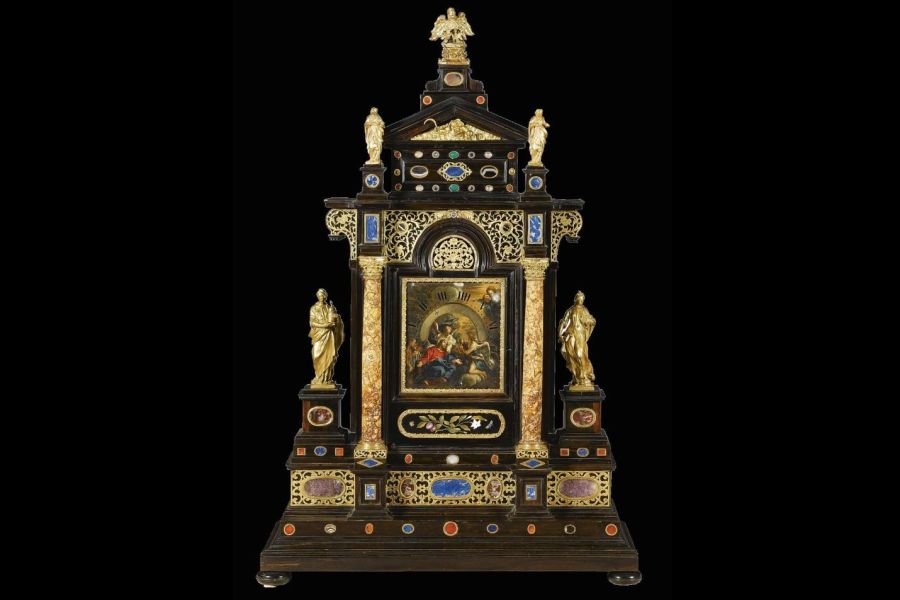
Wondering hours displays are amongst the most visually interesting ways to display time. Perhaps only coming second to HYT’s fluidic system. Weirdly, for a complication that appears so futuristic, we have Pope Alexander VII the Magnificent, who ruled the Papal States from 7 April 1655 to 1667, and the Campani brothers to thank for its creation. His Holiness requested a clock that could be easily read during nighttime and that had a quiet mechanism since he was an insomniac. The Roman watchmaking brother delivered, a year after his ascendancy, such a clock. It could be lit from the back with candles and most importantly for watchmaking history, the hour was displayed in a rotating semicircle that needed to be replaced every hour. Thus, a wonderful complication was invented (during the Renaissance), the Pope slept soundly, and a poor guy had to be awake during the nigh changing the platform (I assume).
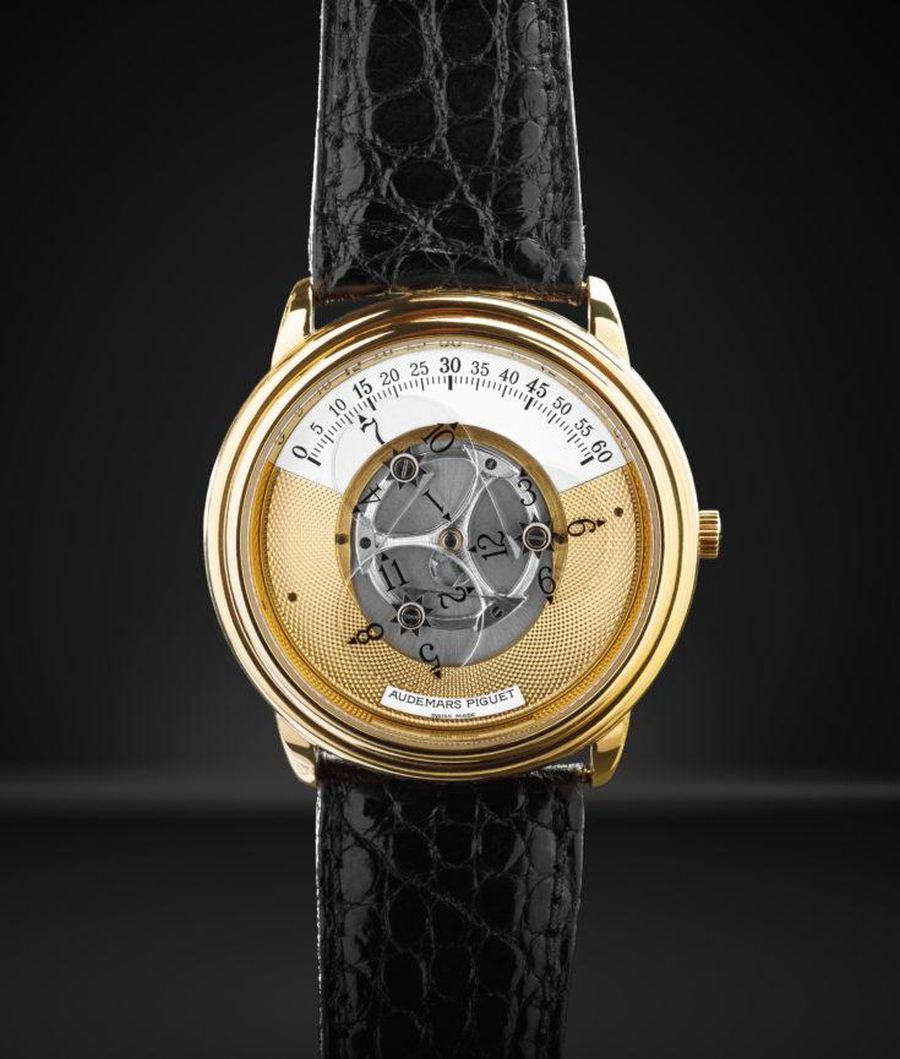
 The complication made its way into more clocks and then pocket watches but it was only taken on by Audemars Piguet 300 years after in 1989 after the mechanical watch industries rebound from the quartz crisis when creativity was plenty. After a watchmaker of the brand rediscovered the complication in the Journal Suisse d’Horlogerie, the first models started coming out in the 90s till 03. Their most famous models were called the Star Wheels because of the star shape support of the disks. Unlike Urwerk who’s defined by this manner of displaying the time, AP stopped producing them but now, after an almost 20-year hiatus, it is back under the umbrella of the Code 11.59.
Design
You’ll notice that the base design is still the same but that it has been modernized aesthetically and materially. The 41mm diameter x 10.7mm high Code 11.59 case is a three-part construction, here forged in 18k white gold, the bezel holds the sculpted lugs and along with the screw in case back create a white gold sandwich with a black ceramic center. The signed crown at 3 o’clock is also a mixture of ceramic a white gold. The two-tone case does lean towards the sports side of watches but since it’s white gold and it’s going for a modern dress look for the dial, we can excuse the 30m of water resistance. Decoration-wise, most areas are brushed and polishing is reserved for refinement touches on the lugs, crown, and thin bezel. The result is a handsome case that tonally matches the dial.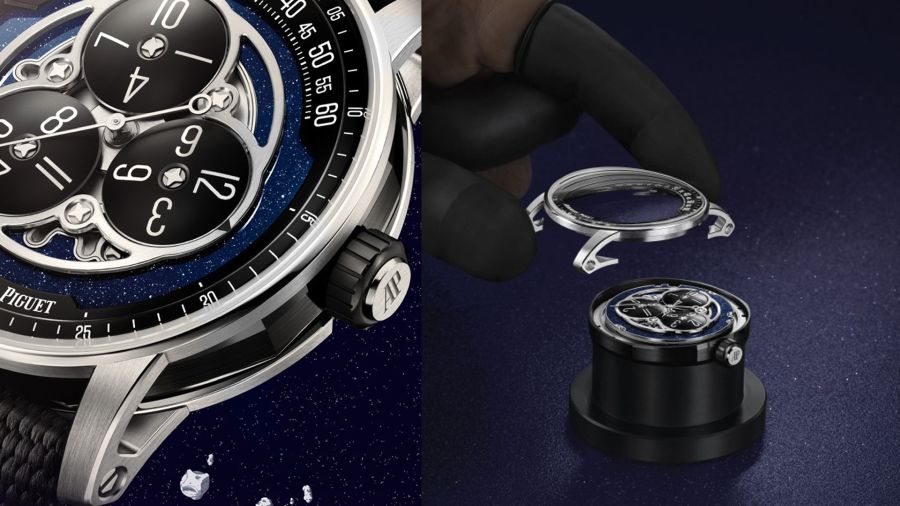 The point of this watch is to showcase the wandering hour’s complication and thus, under the double domed sapphire crystal, the mechanism is exposed like the original models. Present are the star-shaped components that gave them and this piece’s name, located at the center of the three disks and flaking them. The rotating plates are no longer sapphire and are now made of aluminum that’s been slightly domed then coated in PVD black, receive opaline sandblasted finishing, and finally, the white numerals are printed on top. Black triangles are painted on the borders of the plates and that is what you can use to read the minutes as it traverses the 120-degree angled minute track between 10 and 12 o’clock. The number of the hour will be aligned with the base of the triangle.
 The minute track is for the first time joined by a seconds track which is indicated by a gold central seconds hand. Both are attached to the bezel, have a black glossy finish, and their height adds to the dial’s depth. They frame the blue aventurine dial which paired with this complication, makes the three discs seem like galaxies traveling through space held close together by their gravitational pull on each other. A truly brilliant choice. Holding this grail-level watch to the wrist is a textured black rubber-coated strap with an 18k white gold pin buckle.
Movement
 Besides the dial, the sapphire display case back also showcases the in-house caliber 4310. This movement is housed in the regular time-only models of the Code 11.59 as the 4309 but for this model, it has been equipped with a wondering hours module that not only rotates the entire apparatus but also enables the disks to rotate on their axis by activating the star-shaped wheels. It doesn’t seem like the added mechanisms to display the time takes a toll on the power reserve since it will still last 70 hours on a full wind, running at 28,800 vibrations/hour. Power is derived from the rose gold skeletonized rotor or through the crown. The caliber is predominantly finished with cotes de Geneve and beveled edges.

Specifications
Case: 41mm x 10.7mm, 18K white gold top and case back, ceramic case middle and crown, double domed sapphire crystal with AR coating, sapphire case back, and 30m water-resistant; Dial: Blue aventurine dial, black opaline wondering hours aluminum discs, 18k white gold hand, and black inner bezel; Movement: 4310 automatic calibers, rose gold rotor, 70 hours of power reserve, 32 jewels, 28,800 vibrations/hour, and 261 components. Strap: Textured black rubber-coated strap with 18k white gold pin buckle.
Concluding Thoughts
It seems that AP woke up this year determined to prove that the Code 11.59 was the amazing thing that they build it up to be up to the point of release in 2019. For me personally, they have been successful in doing so for the most part. Just look at the Audemars Piguet Code 11.59 Openworked and FlyingTourbillon 2022, Flying Tourbillon Openworked Chronograph, and Grand Sonnerie Supersonnerie in the Artistic Craft category of GPHG that we’ve covered in article form. The Code 11.59 collection is becoming way more interesting than the Royal Oak and watches with complications like this Star Wheel only improve the perception of the line. I find it wonderfully weird that this is a time-only watch but has the gravitas of a tourbillon. The piece is now part of the regular collection and I hope to see more iterations. Mainly I would like the return of the sapphire disks. Acquiring this will mean spending $57,900 at your nearest AP location. Compared to the regular time-only models this is about 20,000 dollars more. The asking price isn’t that crazy compared to what you’ll have to spend to get vintage or early 2000 pieces. And you’re getting a lot more here!